
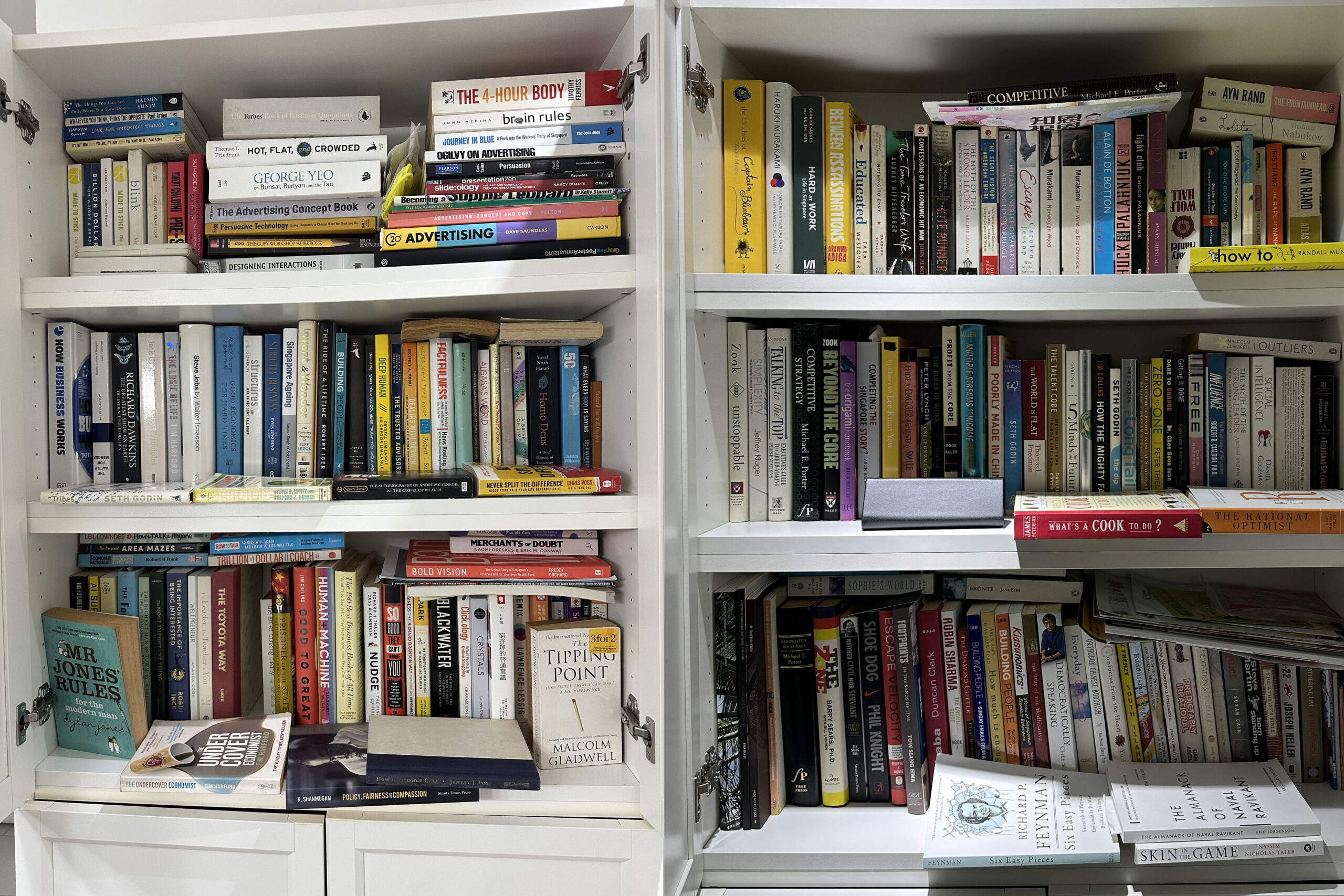
I have always been a bookworm. Not because anyone made me, but because I was curious and restless and looking for answers that school was not designed to give. By the time I entered university, I had already started and failed my first business. By the time I graduated, I had started my third. Today, across our group of companies, we employ about 100 people and operate more than 25 locations in Singapore.
People sometimes ask me what business books I would recommend. I find this question difficult to answer honestly, because the books that mattered most to me did not matter because of what they said in isolation. They mattered because of when I read them, what I was going through at the time, and how they interacted with each other over years.
A book read at 14 lands differently than the same book read at 36. And a book read in combination with many others builds something none of them could build alone.
What follows is not a ranked list of recommendations. It is an honest account of nine books that, looking back at my shelf, shaped how I think, how I build businesses, and how I try to lead.
———
Starting the Engine
Rich Dad, Poor Dad — Robert Kiyosaki
I first encountered this book at 14. I was impressionable, and I took its advice to heart — particularly its concepts on cash flow, assets versus liabilities, and the mindset of business owners versus employees.
Looking back, the book is imperfect. Its financial advice is often oversimplified, and some of its claims do not hold up under scrutiny. But that is not why it mattered. It mattered because it gave a 14-year-old in Singapore permission to think about money, work, and independence in a way that nobody around me was thinking about them. It planted a seed: that there was an alternative to the prescribed path of study, get a job, climb the ladder, retire.
That seed led me into a string of part-time jobs in laptop sales, then into service work like web design and photography, and eventually to starting my first gym at 20, fresh out of National Service and just before entering NTU. It failed in 2011 due to cashflow issues — which, ironically, is the very thing Kiyosaki warned about. But the attempt itself was a product of the mental shift this book triggered.
I would not recommend this book uncritically to anyone today. But I remain grateful for what it did for me at that age: it made entrepreneurship feel possible, not just for the privileged or the lucky, but for anyone willing to think differently about how money works.
———
Finding Your Own Path
The Element — Ken Robinson
Ken Robinson’s argument is that people do their best work at the intersection of natural aptitude and personal passion — what he calls the element. The conventional education system, he argues, systematically narrows children toward conformity rather than helping them discover where they naturally thrive.
I bought his book after discovering his TED Talk around 2008, and wanted to read more about what he thought.
I read books and pursued interests because I was curious, not because they improved my odds of getting into a school or scoring better grades. None of it sat on any career-planning worksheet. It came from following compounding interests rather than the prescribed path many Singaporeans, especially those from backgrounds like mine, are expected to take.
Robinson also shaped how I think about my own children. I have two, both below twelve. I have made a deliberate choice not to optimise their environment for comfort. I want them to experience some friction in daily life. Comfort breeds complacency, and a perfectly curated environment does not prepare them for the world they will actually have to navigate.
The deeper lesson from Robinson is that the most valuable thing you can do for a young person is not to hand them a map. It is to help them develop the confidence to explore without one.
———
Learning to Navigate Institutions
The Rules of Work — Richard Templar
In 2008, when I was 18, I worked at Alexandra Hospital with an introduction to the organization by the then CEO, Mr Liak Teng Lit. He was one of the most consequential healthcare leaders Singapore has produced. Under his leadership, Alexandra Hospital topped the Ministry of Health’s Patient Satisfaction Survey for six consecutive years. He was also deeply committed to Toyota Production System thinking — the hospital was a pioneer in applying lean management principles to healthcare in Singapore.
I was young, surrounded by senior professionals, and trying to be useful without getting in the way. I was given the opportunity to spearhead the website development, and had to speak to management, doctors, nurses and their call centre agents for their perspectives. Templar’s book was a practical survival manual for exactly that situation. It taught me to read the room, to build credibility through competence rather than visibility, and to understand how organisations actually function beneath the formal structure.
For a young person trying to operate effectively inside institutions, it is quietly one of the most practical things you can read.
———
Understanding How People Decide
Influence — Robert Cialdini
Cialdini’s six principles of persuasion — reciprocity, commitment and consistency, social proof, authority, liking, and scarcity — are well known. What is less discussed is how powerful they become when they are designed into a system rather than applied as sales tactics.
Across our businesses, we do not run a marketing-heavy business. Movement First and Javy Sports create value through being reliable and dependable, not being the cheapest. We do not do hard sales. There is no lock-in contract at Arkkies. No large upfront payment. No penalty for leaving. On paper, this looks like we are giving away all our leverage. In practice, it creates something more durable than any contract: genuine reciprocity.
Members who pay $55 a month for a gym (or various prices across our brands) that competitors charge $100 or more for feel they are getting disproportionate value. That feeling drives word-of-mouth without us asking for it. The no-contract model, paradoxically, increases real retention — because people stay by choice, not by obligation. And every new outlet we open in a new neighbourhood is social proof at scale: it signals to the next neighbourhood that this is something real and growing.
Cialdini taught me that the most effective persuasion is structural, not verbal. You do not convince people to stay by arguing with them. You design the experience so that staying is the obvious choice. The best marketing is a product so good that your customers do the marketing for you.
———
Leadership as Stewardship
The Leader, the Teacher, and You — Lim Siong Guan
Lim Siong Guan was Head of Civil Service in Singapore, Permanent Secretary across multiple ministries, and later Group President of GIC. He is arguably the most influential public sector leader Singapore has produced in terms of institutional thinking.
His argument is that a leader’s purpose is not personal achievement. It is building the people and institutions that outlast them. Leadership is stewardship. The measure of a leader is not what they accomplish personally, but what the organisation can accomplish without them.
When I read this book after it was published in 2013, it gave me the language for something I had already witnessed but could not yet articulate. Five years earlier, at Alexandra Hospital, I had watched Liak Teng Lit lead in exactly the way Lim describes. He was not just running a hospital efficiently. He was building an institution that could sustain its own culture of excellence. He was developing people, not just directing them. I saw it at 18 but did not fully understand what I was seeing. Lim Siong Guan’s book, arriving years later, retroactively made sense of that experience. Sometimes the theory comes after the observation. I enjoyed the book so much, I emailed the publisher to buy in bulk, and gave it to close friends.
———
The Discipline of Continuous Improvement
The Toyota Way — Jeffrey Liker
I came to this book through Alexandra Hospital. In 2008, Singapore’s healthcare system was actively adopting lean methodology, and hospitals were sending managers to Japan and America to study the Toyota Production System. I was sitting next to someone who was operationalising those ideas in real time. So when I bought the book, it was not abstract. I could see the principles playing out in the institution around me.
The concepts that stayed with me most are kaizen (continuous improvement), genchi genbutsu (go and see for yourself), and poka-yoke (mistake-proofing through design). They sound like management jargon until you see what they look like in practice.
Here is one example from our business. We noticed that cables on our gym equipment were wearing out faster than expected. The normal response would be to replace them and move on. Instead, we took cable samples from mainstream brands — the industry benchmarks made in USA or Europe. We sent those samples to our factory as a reference standard. Then we sourced candidate cables from manufacturers in Canada, the United States, Japan, and Europe. We ran comparative strength tests. We settled on a Japanese-made cable that significantly outperformed the default Chinese-produced alternative. We now buy it in bulk and pre-stock it across our network.
That process — treating a recurring problem as a defect in the system rather than an event to manage, going upstream to understand root causes, testing alternatives rigorously, and permanently fixing the input — is the Toyota Way applied to gym maintenance. We do the same with bearings, pulleys, and every other high-wear component. We accept that the factory ships with Chinese bearings because insisting they use Japanese bearings is not in our control given our relatively small order size. But the moment a bearing fails, we make sure it gets replaced with a Japanese one that lasts significantly longer. Over time, every machine in our network quietly improves through its maintenance cycle.
Nobody gives you an award for upgrading bearings. But across more than 20 outlets over several years, the cumulative effect is a member experience that is imperceptibly but consistently better than every competitor — built not through grand strategy but through the relentless discipline of making each small thing a little better, every time.
Be careful not to apply ideas like TPS too early, or in areas you do not yet control. At the beginning, we were small, budget-constrained, and still trying to get factories to take our orders seriously. In that position, lecturing them about defects or process discipline would have been pointless. The only leverage I had was to leave and find a better factory.
———
Seeing the Whole System
The Fifth Discipline — Peter Senge
A mentor introduced me to this book when I was about 15. I understood maybe a third of it at the time. I understood the rest only after spending a decade building businesses.
Senge’s central argument is that most chronic problems in organisations are produced by system structure, not by individual failure. If you only react to symptoms, you keep the deeper structure intact and therefore recreate the same results. The alternative is to learn to see patterns, feedback loops, time delays, and shared assumptions before they harden into costly outcomes.
This way of thinking is now so deeply embedded in how I operate that I sometimes forget it is not how most people see things.
When we decided to open Arkkies, it was not because we woke up one day and decided to run gyms. It was because we could see, through a systems lens, that our equipment supply business was structurally vulnerable to disintermediation. Our gym customers could eventually go to the same factories we were sourcing from. Or the factories we sell to could try to reach our customers directly. Instead of fighting that trend with lower prices or more discounts, which would only have treated the symptom, we moved downstream and became our own customer. That created a reinforcing loop. We also understood the consumer problem firsthand: as parents with less time than before, we could see that many gym options were either too expensive or unfairly structured around lock-in contracts.
I have returned to The Fifth Discipline recently, and it reads completely differently now. The same words carry meaning they could not carry when I was 15, because now I have lived the systems Senge describes. The book did not change. I changed.
———
Building the Flywheel
Good to Great — Jim Collins
Collins’s flywheel concept is the one that gave me language for something I was already doing instinctively. A flywheel is a self-reinforcing cycle where each turn makes the next turn easier. The key insight is that there is no single defining action, no miracle moment. It is the cumulative effect of consistent pushes in a coherent direction.
Our flywheel looks like this: Movement First sources equipment directly from factories. That equipment goes to general customers and Arkkies outlets. Arkkies also gives Movement First staff meaningful work during lull periods. Over time, we realised that people prefer consistently busy work to cycles of slack and overload, and gym buildouts help smooth that curve.
Those outlets generate maintenance data that flows back to Movement First. Movement First uses that data to source better components for all its customers. KC Metal fabricates custom pieces. The lower buildout cost enables faster expansion. Faster expansion increases procurement volume. Higher volume strengthens factory relationships. Stronger relationships reduce per-unit costs. And the cycle continues.
None of those individual steps is dramatic. There is no single genius move. But together, turning consistently for more than a decade, they produce a cost structure and operational capability that is special and hard to replicate.
Collins also introduced me to Level 5 leadership — the idea that the most effective leaders are not the most charismatic but the most disciplined, the most willing to confront brutal facts, and the most focused on building something that endures beyond themselves. That connects directly to Lim Siong Guan. And it connects to the work I still need to do.
———
Skill Before Passion
So Good They Can’t Ignore You — Cal Newport
I first came across Cal Newport through his blog and kept finding myself sharpened by his thinking before I eventually bought the book. Experiences like that probably shaped my own desire to write publicly too.
Newport’s thesis directly contradicts the popular advice to “follow your passion.” He argues that career capital — rare and valuable skills that the market cannot ignore — must come first. Passion follows mastery, not the other way around.
This matches my experience exactly. We did not start Arkkies because we were passionate about running gyms. We started it because other than spotting the market gap with unfair consumer practices, we had spent eight years building capabilities in equipment sourcing, factory relationships, logistics, maintenance, and supply chain management. Those capabilities made us structurally better at running gyms than anyone who started from the gym side. The passion for what we are building came after the competence, not before it.
Newport’s framework also explains why I am sceptical of the advice to “just start.” Starting without skill is how I failed my first gym in 2011. Starting with accumulated career capital is how we scaled Arkkies from one outlet to over 25 in five years. The difference was not courage or motivation. It was the decade of capability building in between.
For anyone young and reading this: do not chase passion prematurely. Build skills that are genuinely rare and valuable. Get so good at something specific that opportunities come to you. The passion will follow — and when it does, it will be grounded in something real.
———
Is This Normal?
People sometimes ask me how I have read so many books. The implicit question is whether this is normal. I do not think it is typical, at least not in the way reading has functioned in my life.
Most adults read somewhere between zero and four books a year. Among those who do read, the majority absorb one or two ideas at a surface level and move on. The book does not change how they operate. It is consumption, not formation.
What I have done is different in three ways, and I think it is worth being honest about that rather than pretending reading is some universal habit that anyone can casually pick up.
First, I started early and sustained it. Reading seriously from 12, across disciplines, for over two decades. That is not a habit. It is a compounding investment with a 24-year runway. Most people who read business books start in their mid-twenties when they hit their first management role. By that point I had already been reading for over a decade. The gap is not just in the number of books. It is in the years of accumulated cross-pollination between ideas.
Second, I read across domains rather than within one. My shelf spans persuasion psychology, systems theory, lean manufacturing, institutional leadership, education philosophy, career strategy, and personal finance. I picked up books on biotech, engineering and religion out of pure curiosity. Most readers stay within their lane — a finance person reads finance books, a marketer reads marketing books. Reading across boundaries is where the unexpected connections happen: Senge’s systems thinking applied to Toyota’s production methods, filtered through Cialdini’s understanding of human behaviour, grounded in Lim Siong Guan’s philosophy of institutional stewardship. No single book gave me that synthesis. The combination did.
Third, and this is the part that probably matters most: I applied what I read. Many people read for information or stimulation, but fewer convert what they read into operating principles. They agree with the ideas. They may even discuss them. But the ideas stay in the book. They do not cross the gap into daily operations and actual decisions. I read Senge at 15 and eventually built a vertically integrated business group that runs on systems thinking principles. I read Liker and designed a maintenance process that is functionally kaizen. I read Cialdini and built a business model where the structure does the persuading. The reading became operational. That is where the value lives, and it is where the vast majority of readers stop.
I do not say this to boast. I say it because I think the compounding effect of reading over two decades is genuinely very difficult to replicate quickly by someone who starts at 30. That is not arrogance. That is just how compounding works. A dollar invested at 14 is worth more than a dollar invested at 34, and the same is true of ideas.
If you are young and reading this, the most important thing I can tell you is not “read more.” Everyone says that and it changes nothing. What I would say is: read above your level, read across boundaries, and do not worry about understanding everything the first time. Some books will not make sense until you have the experience to unlock them. That is fine. They will be waiting for you on the shelf when you are ready.
———
The Compounding of Reading
Looking at this list, I notice that none of these books overlap much in content. Cialdini teaches how people decide. Templar teaches how to navigate institutions. Robinson teaches how talent develops. Lim Siong Guan teaches how leaders build people. Liker teaches how to improve processes. Senge teaches how to see systems. Collins teaches how to build flywheels. Newport teaches how to build career capital. Kiyosaki, for all his flaws, teaches a teenager that there is an alternative.
Taken together, they produce a way of operating: think in systems, improve through disciplined iteration, design structures that work without enforcement, build skill before claiming passion, and lead by developing others rather than directing them.
None of this happened by design. I did not sit down at 12 and plan a reading curriculum. I simply followed curiosity, often far above my comprehension level, and trusted that the ideas would eventually find their way into practice.
The honest truth is that reading is the earliest investment I ever made, and it is still generating returns. The books did not change. I changed. And every time I return to one of them, I find something I was not ready to see before.
That is the compounding of reading. It is slow, it is invisible, and it is the most undervalued asset on any entrepreneur’s balance sheet.
Leave a Reply