
I recently saw a limerick displayed prominently on the wall of a primary school:
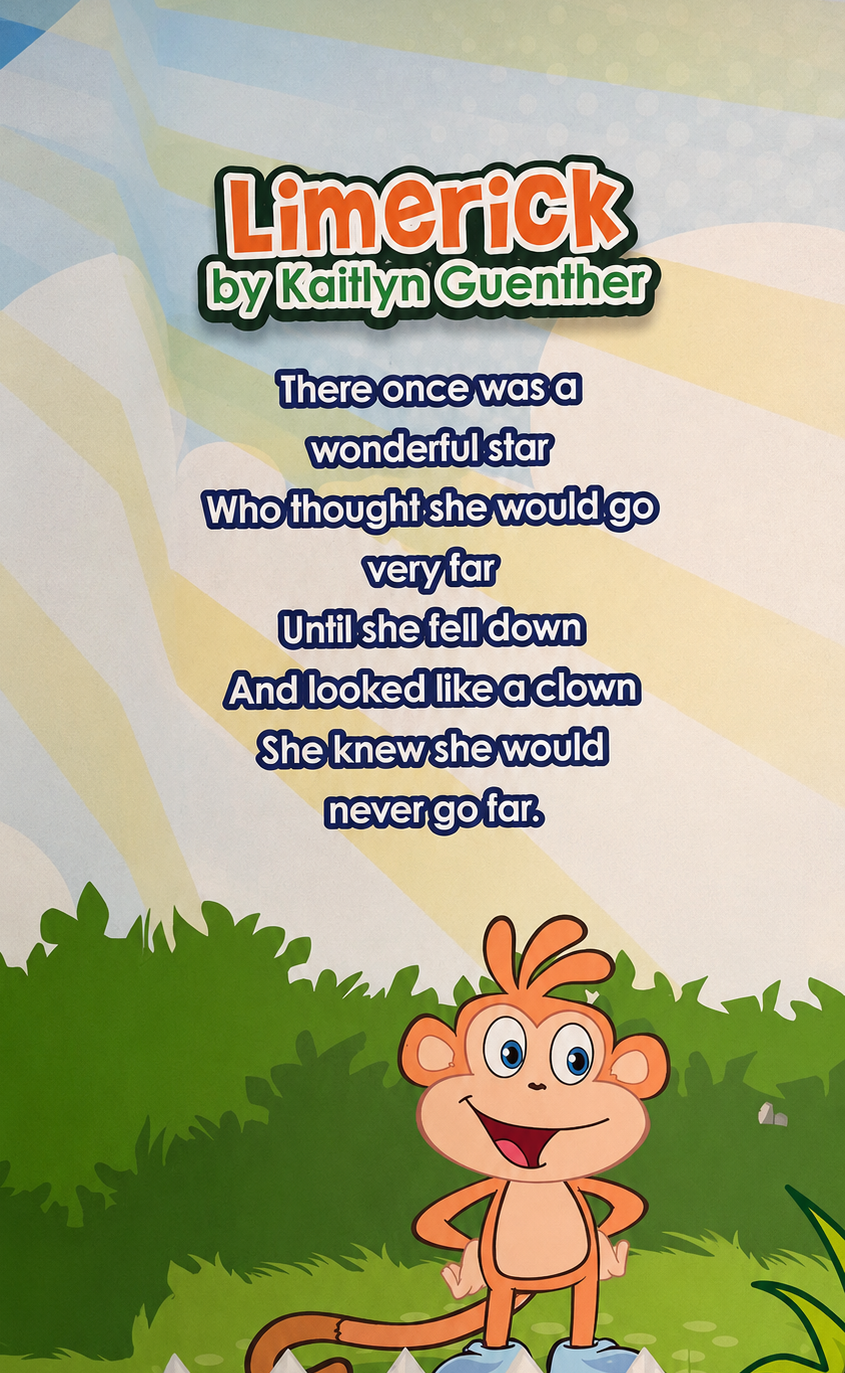
Perhaps it was chosen because it rhymed correctly. Perhaps nobody thought much about it before enlarging it and putting it on a wall for hundreds of children to read every day. But look at what it actually says. A wonderful star believed she could go far. She fell once, embarrassed herself, and concluded she would never go far after all. That is the lesson, framed and laminated, in a primary school.
Nobody displayed that exact poem when I was growing up, but the underlying message felt familiar: behave properly, follow the prescribed path, avoid looking foolish, and do not stray from what the adults around you believe a successful child looks like. I was never good at being that child.
By conventional measures, I did well in school. I scored 259 for PSLE, closer to 261 with Higher Chinese bonus points. I understood what was taught, absorbed information quickly, and read constantly outside of class. But I could not manage the basic mechanics of being a student. I walked around. I talked too much and distracted my classmates. I struggled to remain seated and quiet. I was bad at filing. The disruption was rarely deliberate, but it was disruption all the same.
This confused my teachers. How does someone produce good grades and behave this badly? I suspect some of them, particularly in secondary school, quietly concluded I would end up a reject of society. This was how I felt talking to many of them back then.
I do not blame them individually. They were managing large classes inside a system that depended on order, and a child who could not stay in his seat created real problems for them regardless of his intentions. But a child does not see the institutional constraint. He only sees the judgment. The recurring message was that I was troublesome, undisciplined, and wasting whatever ability I had. My results proved I was not stupid, which probably made things worse — from their perspective, I was capable of complying and simply refusing to. From mine, I was trying to survive an environment that felt psychologically suffocating.
The strange thing is that I never hated learning. I read widely on my own. I took up part-time jobs while still in secondary school. I became interested in business long before anyone formally taught me anything about it. I learned readily whenever I could see the purpose behind the knowledge, or had some say in where it might lead. What I hated was learning packaged inside hours of compulsory stillness, repetition and obedience. You sat through several hours of lessons, had recess, sat through several more, went home, and were expected to keep studying. The next day it restarted.
Even the activities meant to provide variety became another form of repetition. I was selected for the competitive team in my CCA, and after two years I realised I did not want to keep practising the same things for a succession of national competitions that meant very little to me. So I quit. My seniors and teacher-in-charge were furious. I had taken a place someone else could have had, received training, and now forced them to prepare a replacement. They were not wrong about the inconvenience. But I could not understand why leaving an activity that no longer made sense to me was treated almost as a moral betrayal. That was how much of school felt: once the institution assigned you a role, you were expected to keep performing it, whether or not it was helping you grow.
With my results, the expected path was junior college and then university. I chose polytechnic instead. It was one of the first major decisions I made for myself, and probably one of the most important.
Polytechnic was still school. There were lectures, assignments, examinations, deadlines. But the structure felt entirely different. There were breaks between modules. Timings varied. There was more project work, and knowledge was applied rather than merely received. Most importantly, school no longer occupied my entire psychological world. I could sit through a two-hour class because I knew it would end and my time would return to me. I could run small businesses on the side, work on real projects, and come back to class understanding why certain concepts mattered.
I began enjoying education. University was similar — the classroom remained uncomfortable, but it became tolerable because it was only one part of a larger life I was directing myself. The child whom teachers expected to become a social reject did not transform into a different person. The environment simply became less hostile to the person I had always been.
Here is the part that troubles me most now. My grades protected me. However unhappy I was, my results gave the system a reason to keep believing I might eventually amount to something. Even when teachers were angry with me, the marks suggested I still had a future. My grades formed a layer between my behaviour and the harshest possible conclusions about my character.
Now imagine the child who cannot tolerate the structure and also cannot produce the results. The child who cannot sit still, cannot learn at the speed the lesson moves, cannot organise a file, and cannot deliver an examination score impressive enough to keep the adults hopeful. That child gets labelled lazy, defiant or incapable long before anyone discovers what he can actually do. He might be good with his hands, or understand machines intuitively, or be able to sell, persuade, cook, repair, organise people or care for others. He might learn through movement, experimentation and repeated practice rather than textbooks. But schools discover the abilities that can reveal themselves inside school. A child who performs badly within that environment is gradually treated as though he will perform badly everywhere. That is a dangerous conclusion to reach about a ten-year-old.
None of this is an argument against structure. A teacher cannot redesign every lesson for forty different children, and children cannot simply do as they please. It is an argument against confusing compliance with capability. The ability to remain seated for long periods is useful, but it is not intelligence. The ability to organise worksheets is useful, but it is not character. The ability to reproduce the correct material in an examination is useful, but it is not curiosity, judgment, or the capacity to solve unfamiliar problems.
Ironically, the traits that made school painful became valuable later. I was uncomfortable following a path simply because everyone else was on it. I enjoyed working without a predetermined answer. I could stay interested in a problem precisely because it kept changing. That is probably why I enjoy business. There is no syllabus. The market does not hand you a rubric. You can make the correct decision and still lose, or make an imperfect one and somehow survive. Every answer creates another question.
The same applies to the physical activities I gravitate towards. I understand why people love standardised events like Hyrox, where the movements are fixed and results compare cleanly. But I am drawn to climbing, calisthenics and adult gymnastics, where there is no endpoint — only a harder route, a cleaner movement, another skill. Progress is measurable without being reduced to a single ranking.
And I do not dislike structure itself. The businesses I have built contain enormous amounts of it: leases, payroll, construction schedules, operating procedures, stock systems, financial controls. The difference is that the structure serves a purpose. In school, too often, compliance with the structure became its own purpose without a reason.
I am not arguing for abandoning academic rigour, or pretending every child has the same strengths. I am arguing for more legitimate ways to succeed: real exposure to trades, entrepreneurship, design, technology, sport and caregiving before the academic hierarchy convinces children these are consolation prizes; teachers supported in distinguishing between a child who refuses to learn and a child who cannot learn under the conditions imposed; assessments that test whether knowledge can be used rather than reproduced; and room to fail without one failure hardening into an identity. None of this is easy. A national system educates hundreds of thousands of children, and standardisation is partly what makes that possible. But a school can produce orderly classrooms and respectable examination results while leaving many children convinced they are defective, and efficiency alone will never surface that cost.
I was fortunate. I had strong grades, read widely, found work early, and had enough confidence — or stubbornness — to choose the less conventional route despite qualifying for the standard one. Many children have none of those protections. Some will leave school believing they are lazy because they could not sit still, or unintelligent because they could not learn through worksheets. Some will stop trying because the institution meant to develop them spent years documenting what they did badly. By the time society finally offers them freedom, they may no longer believe they deserve to use it.
School made someone like me — academically capable, naturally curious, constantly reading — hate being there. I sometimes think about what it does to the child who struggles academically and cannot tolerate the structure either. And I think about that star on the wall, who fell down once, and was told in rhyme that she would never go far.
Leave a Reply