
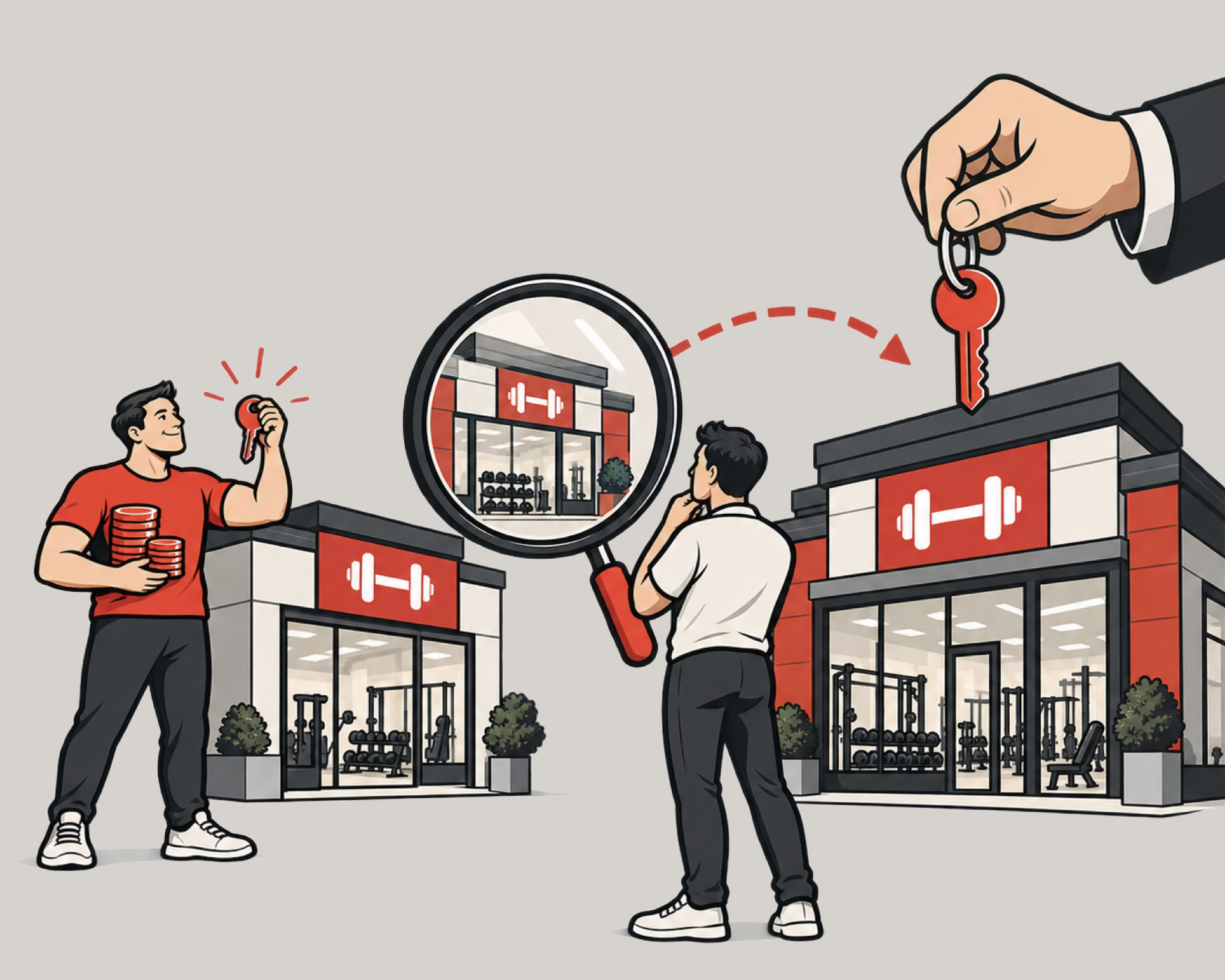
 One of the most convincing things a franchise salesperson can tell you is that the existing franchisees are doing well. You might even know one of them. They opened a gym several years ago, recovered their investment, and now own a second outlet. The brand keeps expanding. You train there yourself. It feels like a business you understand.
So when someone warns you about buying a franchise, your first reaction is understandable. If the model is so bad, why are those people making money?
That is exactly the question you should ask. Then ask what rent they signed, how much competition they faced, which sites were available, and why HQ offered those sites to franchisees in the first place. Their success happened under a particular set of conditions. You need to know how many of those conditions still exist.
For context, I own fitness and climbing businesses in Singapore, including Arkkies and Fit Bloc. We operate our own gyms and have not franchised our model. That makes me in the same industry, and you should know that before reading my views. I have also opened gyms that worked and closed gyms that did not. Some lessons came with very expensive invoices.
I am writing because people with good careers and substantial savings keep asking about entering this industry. Existing franchisees have their own relationships, contracts and businesses to protect. Former owners may have confidentiality obligations. There are understandable reasons for people to keep their experiences private. I can share what operating gyms has taught me, including the questions I would want someone to ask before putting their savings into one.
You wanted a business. Now you are afraid of losing your slot.
The journey usually starts quite reasonably. You have done well in your career, saved money and already invested in the stock market. After a while, you want something more tangible. You want a business you can walk into, improve, and call your own.
Perhaps you are a doctor, lawyer, banker or another professional who enjoys training. You have fallen in love with functional fitness or fitness racing. Opening a gym seems like a way to combine something you enjoy with an investment that produces income.
Then you attend a trade show. There is a familiar brand, an impressive presentation and a salesperson who explains how much easier this is with an established system. You put down a relatively small deposit to join the waiting list. The commitment feels manageable. For the next few months, you picture yourself owning the outlet.
Eventually, your turn arrives. The premises are smaller than you imagined, or the rent is higher than you expected. But they are near an MRT station or a town centre. HQ says the numbers work, and there are other people waiting behind you.
Suddenly, rejecting a bad deal feels like losing an opportunity. You have already waited. You have already told people. You have already started becoming this version of yourself in your head.
That is an expensive position from which to negotiate. The fact that somebody else wants your slot tells you there is demand for the franchise. It tells you very little about whether that particular gym will produce a worthwhile return.
Before signing anything further, ask yourself a simple question: would I take this exact site, at this exact rent, if I had never paid a deposit or waited for my turn?
The early franchisees were funding a different stage of the business
Early in a network’s life, HQ faces a straightforward problem. It wants more outlets, but opening them takes capital, people and time. There are deposits to pay, premises to renovate, equipment to buy and losses to fund while membership builds.
A franchisee solves several of those problems. They bring the money and take responsibility for the local business. At that stage, giving a strong site to a franchisee can be a sensible trade for HQ. Keeping every good opportunity means finding the resources to open every good opportunity.
That explains why an early franchisee could receive a genuinely attractive site and do well. Their success story can be completely true.
Now follow the network forward. It grows to dozens of gyms, perhaps more than a hundred. It earns recurring fees, builds an operating team and gains access to more funding. Once HQ has enough capital and people to open outlets itself, it can afford to retain the sites it finds most attractive.
This changes the question for a new franchisee. You need to understand how sites are allocated between HQ and franchisees today. If HQ keeps the strongest opportunities while offering the more marginal ones to outside investors, those investors are funding a very different proposition from the early owners.
The same question applies at renewal. Who holds the lease? Who negotiates with the landlord? What rights survive when the franchise term ends? A profitable outlet is valuable, and continued access to its location deserves as much attention as getting it open.
You are buying today’s opportunity based on yesterday’s success story. A testimonial from someone who entered under different conditions does not settle whether your deal makes sense.
Your success can become the sales pitch for your next competitor
The franchise pitch encourages you to think of HQ as the experienced partner helping you succeed. In many respects, both sides do want the outlet to work. But you are paid differently, and that difference matters.
Where royalties are charged on revenue, HQ earns from sales before you find out whether there is anything left after rent, wages and the other bills. Selling another franchise also brings another initial fee. Your priority is the return from your outlet. HQ has an interest in total network revenue, franchise sales and the value of the wider business.
Those interests can pull in different directions. Consider a simplified example with a 10% revenue royalty, used purely to show the arithmetic. Your outlet makes S$70,000 a month, so HQ collects S$7,000. A second outlet opens nearby. Your revenue falls to S$45,000, while the new outlet also makes S$45,000. HQ now collects S$9,000 across both, plus whatever initial franchise fee was agreed. Your outlet has lost S$25,000 of monthly revenue while carrying much of the same cost base.
The network has grown. Your investment has deteriorated.
This is why the territory clause matters. If the agreement allows HQ to redraw the boundary when market conditions change, the protection is only as strong as those qualifications. Get the actual wording reviewed, including what it says about company-owned outlets and other formats operating nearby.
Under an arrangement that permits that expansion, your successful gym helps demonstrate demand for the next franchise sale. Your success becomes the sales pitch for your next competitor.
A private equity buyer has its own objectives
An acquisition announcement can sound reassuring. A sophisticated investor has bought into the brand, so surely that validates the opportunity.
I want to know where the money went. A purchase from existing shareholders pays those shareholders. Fresh investment into the operating company funds the business. A debt-funded acquisition adds a different set of obligations. The headline alone tells you very little about which of these has happened.
Private equity ownership also introduces an investor with a target return and an eventual exit to consider. I become wary when the plan centres on acquiring more businesses, adding outlets, increasing fees and selling a larger group at a higher valuation. All of those activities need to be examined from the perspective of the person paying to open one gym. What improves that person’s return?
Toys “R” Us is a useful warning about assuming that well-funded owners guarantee a healthy business. An investment group bought it in 2005 in a US$6.6 billion acquisition. The company filed for Chapter 11 protection in September 2017; its own SEC filing stated that its indebtedness had adversely affected its financial condition. Debt was part of a broader commercial problem, but the brand’s scale and recognition did not protect it from financial distress.
Research on private equity finds that outcomes vary substantially across deals and firms. My concern is specific: a franchisee should understand the debt, fees and expansion incentives that come with an ownership change. “A large fund invested” is an introduction to those questions.
S$9 per square foot sounds small until you multiply it
When someone tells you S$9 per square foot per month near an MRT station is workable, or S$12 near a town centre is acceptable, turn that statement into a monthly bill.
| Rent calculation | 1,500 sq ft near an MRT station | 3,000 sq ft near a town centre |
| — | —: | —: |
| Rent per sq ft per month | S$9 | S$12 |
| Monthly base rent | S$13,500 | S$36,000 |
| Annual base rent | S$162,000 | S$432,000 |
| Paying members needed for base rent alone, at S$100 monthly revenue each | 135 | 360 |
For these illustrations, S$100 means monthly membership revenue after discounts and excluding any GST due, before royalties and operating costs. Base rent excludes additional service charges or other occupancy costs. Use the full figures in your actual budget.
Those 135 or 360 members pay the base rent. You still have to fund staff, utilities, cleaning, maintenance, insurance, software, payment fees, marketing and franchise charges. You also need to pay for the work of managing the business.
Take the larger outlet. Assume, purely for illustration, that other monthly operating costs are S$20,000, including an appropriate management salary, and revenue-based fees total 10%. With S$36,000 rent, the outlet needs approximately S$62,222 in monthly revenue to cover those costs. At S$100 per paying member, that means 623 members before financing costs, income tax, major equipment replacement or recovering the original investment.
At 800 members, that example produces S$16,000 a month before those remaining items. At 600 members, it loses S$2,000. A forecast that misses its membership target by a quarter has turned an attractive-looking operation into a business requiring more cash.
Now consider the opening period. You are paying bills while building towards the target. And membership has to be maintained: at an illustrative 5% monthly cancellation rate, a gym with 800 members needs 40 replacements every month simply to stay at 800.
A spreadsheet should show how the gym survives that process. Don’t rely only on a column with an impressive made-up membership number.
Singapore is small, and the other operators have calculators too
Experienced operators are looking for premises all the time. Agents send us listings. We visit sites, ask about rent and work through layouts. Many of the opportunities presented to a new investor have already been considered by people who open gyms for a living.
When we walk away, there is usually a reason. The rent is too high for the revenue we expect. Too much of the floor area is unusable. Access is inconvenient, or the location looks better on a map than it feels on foot. Fit-out costs consume the return. The lease is too short to justify the investment.
Singapore is a small market, and a gym’s practical catchment is smaller still. Prospective members have routines, competing options and limits on how far they will travel. A large population somewhere nearby does not automatically become customers walking through your door. Neither does a busy station guarantee sufficient demand at your price.
I once advised a climbing gym operator to aim for roughly S$4–5 per square foot per month and be very cautious above S$6 for the kind of business we were discussing. He signed at S$7 and subsequently struggled. That was my assessment of those economics, rather than a universal rent limit for every climbing gym. But it illustrates how a difference that sounds small in a conversation becomes a large fixed bill every month.
We make mistakes too. Another operator might see an opportunity we missed or have a better format, customer base or cost structure. The useful question is what makes their numbers different. If experienced operators rejected the same site at the same rent, “HQ says it is fine” deserves considerably more investigation.
There is another complication. An outlet can serve a wider purpose for its owner: brand visibility, a regional foothold or testing a new market. A group can deliberately fund those objectives from elsewhere. A franchisee relying on that one outlet to produce income needs a different financial outcome. Seeing another gym remain open tells you very little about whether its owner is earning a return you would accept.
Before you open, understand how you get out
When you buy shares, exiting usually involves placing a sell order at the available market price. A gym comes with a lease, equipment, staff, members and contractual obligations. Closing the doors does not automatically end the bills.
Singapore has no dedicated franchise statute or mandatory US-style franchise disclosure document. General laws, including contract law and misrepresentation law, still apply, but buyers should not assume they will receive a standard package of disclosures or special franchise protections simply because the brand is established.
Before committing, have an independent lawyer explain the franchise agreement and lease together. Establish what happens if you stop trading, whether you have given personal guarantees, who must approve a sale, and what termination, transfer and reinstatement obligations apply. A business that you can afford to open can still be very expensive to leave.
If losses continue, the pressure changes your negotiating position. You want out, but continuing costs money and a clean exit is difficult. A buyer with cash can wait. You cannot wait indefinitely.
This is where an offer from HQ or another franchisee, at a fraction of your original investment, starts to look like relief. You paid for the renovation, the equipment and the difficult opening months. The buyer is looking at what the outlet is worth now. Your spending does not oblige anybody to pay you back.
Even giving away the business is no guaranteed escape. An outlet carrying an expensive lease and continuing losses can be unattractive at a zero purchase price.
The gym can survive while its franchisee fails
Suppose HQ acquires a struggling outlet cheaply, operates it for a period and later sells it to a new franchisee. The equipment is there. The premises are fitted out. There are members, operating records and a story about how a fresh owner can take the business forward.
The original owner’s loss has changed the economics for the next buyer. An outlet bought for S$100,000 is a different investment from one that cost S$500,000 to establish, even if the sign above the door stays exactly the same.
Where the new agreement charges another franchise fee and ongoing royalties, HQ earns from that transaction and the subsequent operation. Whether HQ makes a profit overall depends on its purchase price, operating losses, support costs and resale terms. What matters to you is that your outcome and HQ’s outcome are separate calculations.
The US Federal Trade Commission explicitly advises prospective franchise buyers to investigate failed outlets bought back by franchisors and to examine an outlet’s previous ownership and actual financial performance. Its US disclosure rules do not apply automatically in Singapore, but the commercial question travels perfectly well: who owned this gym before, and what happened to their money?
An outlet count cannot answer that. The network still has a gym at the same address, while one investor has already lost a substantial amount. A photograph of an operating outlet tells you nothing about how many owners have funded it along the way.
Ask for the information that changes the decision
I would want clear answers to the following questions before paying a deposit. These go well beyond asking whether the brand is popular.
– **Which outlets does HQ own, and how did it acquire them?** Separate sites it opened itself from those bought back from franchisees. Ask for opening dates, ownership changes and the reason for each takeover.
– **How are sites allocated now?** Compare the locations, rents and operating conditions of recent HQ openings with the sites being offered to franchisees. Ask what criteria decide who gets a location.
– **What have comparable franchisees actually earned?** Request a meaningful range of results from outlets with similar rents, sizes, ages and catchments. Include weak performers, closures and transfers. Ask what is left after a proper management salary and all recurring fees.
– **What supports the forecast for this site?** Work through achievable membership, collected revenue per member, cancellations, local competitors, opening losses and the full occupancy cost. Establish which fees rise with revenue and which are payable regardless of performance.
– **What protection survives success or failure?** Have the territory, renewal, transfer, guarantee and exit provisions explained in plain English. Ask who controls the lease and what happens when its term differs from the franchise term.
– **Would existing and former owners buy again?** Speak to people beyond HQ’s selected references. Ask how much cash they put in, how much they took out, why they sold, and what remains owed. An owner buying another outlet with profits already withdrawn is more informative than a testimonial about how exciting the brand feels.
Financial information can be commercially sensitive. Anonymised figures or review under confidentiality can help. But a request for your capital needs to come with enough evidence for you to assess the investment. Confidentiality does not make an unsupported forecast more reliable.
I would also pay an accountant who is independent of the sale to challenge the projections. The person helping sell you the franchise has a different role from the person checking whether you should buy it.
Remember to pay yourself and recover your money
When you calculate profit, include the work you are doing yourself. If you handle the accounts, answer members, manage staff and deal with repairs without taking a salary, your time is paying for part of that reported profit.
For someone with a good professional income, this deserves an honest calculation. Put a realistic cost on the work, even if you initially do it yourself. Then examine the return on the money invested.
If you put S$500,000 into an outlet and it generates S$10,000 a month available to return to you after operating costs and an appropriate salary, simple payback takes 50 months. That calculation assumes the cash arrives consistently and ignores the time value of money. Opening losses, financing, taxes or major replacements not already included stretch it further. Compare that timetable with the certainty of your lease and franchise term.
A gym can pay its monthly bills and still deliver a disappointing investment. It can also consume evenings and weekends that you would have preferred to spend working in your profession, training or being with your family.
Put alternatives such as a diversified stock portfolio, including an S&P 500 fund, beside the proposal. Market investments carry their own risks and offer no guaranteed return. They do, however, make you confront the extra work, concentration and difficulty of selling that come with one privately owned outlet. That extra commitment needs to earn its place in your life.
You can still decide to do it
I understand wanting a business of your own. I have spent years building them, and I know the satisfaction of seeing something you created work. There are good reasons to pursue that ambition, including reasons that go beyond the highest possible financial return.
What worries me is watching someone treat a familiar brand, a successful early franchisee and a waiting list as sufficient evidence to commit their savings. Those things make the opportunity feel convincing. You still need to establish whether the particular deal in front of you is worth doing.
If the numbers hold up under a difficult scenario, the terms are acceptable, you can carry the downside and you want the work, then there is a serious decision to make. Walking away from a poor site also leaves you with the capital to pursue a better one.
Before you sign, come back to this: **would you still take this site, at this rent, if you had never paid a deposit and waited for your turn?**
It is your money. Make sure the opportunity makes sense for you.
—
This is the long form content and built for IG here: link.
Leave a Reply